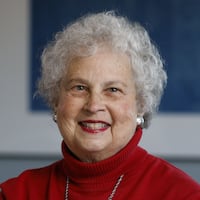
Bachner, who is devoted to carrying on her father’s legacy, was in Cincinnati for the opening of “What, Me Worry? The Art and Humor of MAD Magazine.” The exhibit will be in Cincinnati through March 1.

Organized by the Norman Rockwell Museum in Stockbridge, Massachusetts, the entertaining exhibition traces the history of “MAD” from its humor comic book roots to its status as a mainstream force in American satire. The irreverent magazine is credited with influencing the satire of today —“Saturday Night Live,” “The Simpsons,” “The Daily Show.”
It’s fun to visit an art exhibit where you can hear people chuckling in the galleries. You’ll see more than 150 humorous works of art, including lots of magazine covers. You’ll learn about mascot Alfred E. Neuman, about the mag’s famous fold-ins and the wordless “Spy. vs. Spy.” And you’ll see examples of the work “MAD” artists created for other publications as well.
You’ll get a kick out of the Mothers Day cards from children who didn’t turn out well like Blackbeard, Lizzie Borden, Al Capone and John Wilkes Booth.
You can also watch a new documentary, “When We Went MAD! The History & Influence of MAD.” The film features interviews with MAD celebrity readers, along with MAD artists, writers and editors; affectionately known as the Usual Gang of Idiots.
There’s a lot of entertaining reading in this exhibit, so you may want to see some of it, take a break and have lunch in the museum’s lovely cafe, and then see more.

How he worked
Drucker’s work is touted as one of the highlights of the Cincinnati exhibition.
“You weren’t anybody until Mort Drucker turned you into a caricature for ‘Mad’ magazine,” read the headline in ”Den of Geek" when Drucker passed away at the age of 91 in 2020. Interestingly, Drucker was a “remote” worker.
“He was never on staff, he was a freelance illustrator,” said Bachner. “He initially worked for DC Comics to correct the work of other artists, and eventually did romance and war comic books. But after he lost the job at DC, he didn’t want to put all his eggs in one basket.”
As a result, when publisher Bill Gaines offered Drucker the job at ”MAD,“ Mort Drucker told him he’d be on time with every deadline but wanted to be a freelance illustrator.
Bachner said her father started working for “MAD” in 1954-55 when she was three and her sister had just been born. He worked there until 2011 and the magazine continues to reprint his work from the archives.
Although Bacher and her sister didn’t bother their dad when he was working, his studio door was always fully open. When her father took a break, they’d all convene at the dinette set and converse.
“He’d pour a cup of Sanka and give me a glass of milk and a plate of cookies,” Bachner said.
She said Al Feldstein, editor of “MAD” for decades, said most artists either had a great sense of humor but couldn’t draw or were accomplished artists with no sense of humor. He said her father had both.
“He was never mean spirited and never made somebody look ugly,” said Bachner. A case in point was her father’s caricature of Barbra Streisand.
“It’s obvious that she has a big nose but that’s not who she is. It’s the totality of her entire face along with her body language and how she holds herself and her hands — that’s all her essence. The entire person has to come through. It’s very difficult to draw hands and my father was best known for his hands. He would spend hours and hours drawing hands.”
What most people don’t know, said Bachner, is that over her father’s signature there were always three dots.
“Those mean ‘God Bless America’ because my grandmother had to escape Austria because of the pograms where they were killing Jews. My great-grandmother died of starvation on the way and my Aunt Helen at 16 took my grandmother in steerage on a boat to Ellis Island. My father was able to realize the American dream, and he always felt this was a land of opportunity and you could become anything you wanted to be as long as you worked for it.”
Broadening the audience
The MAD exhibit is accomplishing exactly what curators at CAM were hoping it would.
It’s attracting new and diverse audiences.
“We say we’re the community’s art museum so we need to show works that reflect the interests of the entire community,” said curator Emily Agricola Holtrop. “We hope that multi-generational visitors will come and we are seeing a lot of men. Instead of wives asking their husbands to come to the museum, we have men asking their wives.”
Jim Denker of Kettering is one of the men who thoroughly enjoyed the exhibit.
“I didn’t subscribe to MAD because my parents were very much against that magazine. But my next door neighbors were much more permissive and they had stacks of that magazine so I liked going over there. They were in their house because of older brothers. ”
Ar one point Denker’s dad found him in his bedroom with a few of magazines.
“He was outraged and said I had to promise to throw them away, but being who I am I hid them instead. I was precocious and wanted to read everything. I loved satire and I like spoofing things. I’m irreverent and my parents had zero understanding of satire.”
Denker spent an hour and a half going through the Cincinnati exhibition. He said he learned a lot and recognized many of the artists and their artwork.
“But I didn’t know who they were as people and that was very interesting. One example is that they were talking about the evolution of ‘Spy vs. Spy.’ It was started by a Cuban fellow who had limited English so the comics had very few words. After he passed away and the torch was passed to other artists, they respected what the first guy had done.”

Holtrop said the exhibition not only invites visitors and “MAD” lovers to to reminisce over the magazine’s satirical history and have a good laugh, but also explore the themes and critical historical moments the magazine spoofs.
“Through laughter, generations have learned about important social moments that have shaped this country—"MAD" did that, said Holtrop, who is the Cincinnati museum’s Director of Learning & Interpretation.
The history
- First hitting newsstands in 1952, “MAD” originally launched as an EC comic book series founded by editor Harvey Kurtzman and publisher William Gaines, with its inaugural issue titled “Tales Calculated to Drive You Mad.”
- The publication’s now-legendary parodies of “Superduperman” (issue #4) and “Starchie” (issue #12)—takeoffs on the classic DC Superhero and Archie comics—launched “MAD” into the stratosphere. In 1955, with “MAD” #24, the comic was reimagined as an illustrated magazine, releasing it from the censure of the Comics Code Authority.
- Between 1955 and 2025, over 595 issues have been published, along with numerous specials, books, paperbacks and compilation projects. Now part of the Warner Bros. Discovery family, managed by DC, “MAD” continues with curated reprints, compilations and some new features, and is available at Barnes & Noble’s newsstands, Bookazines or via subscription nationwide.
HOW TO GO
What: “What, Me Worry? The Art and Humor of MAD Magazine”
Where: Cincinnati Art Museum, 953 Eden Park Drive, Cincinnati
When: Through March 1. Hours are 11 a.m.-5 p.m. Tuesday through Sunday and from 11 a.m.-8 p.m. on Thursdays.
Tickets: $12, with discounted rates for students, children, and seniors. Save $2 when purchasing tickets online. The exhibition is free for members and nonmembers every Thursday evening from 5–8 p.m. and on Feb. 27 from 5-9 p.m. during Art After Dark. Photography is permitted.
More info: cincinnatiartmuseum.org
About the Author